Phone

(03) 5633 1110

The History of Trafalgar Golf Club

Based largely on the original work of the late Don Hasthorpe

Established in 1909, Trafalgar Golf Club has a rich and proud history dating back to the beginning of last century. Through the hard work and commitment of Club Members and associates, Trafalgar has been transformed into the impressive course golfers enjoy today.


The Early Years

Trafalgar Golf Club has occupied four locations over more than a century. Founded by an enthusiastic group of golfers when Trafalgar had a population of less than 300 in 1909, just two years after the founding of the nearby Warragul Golf Club.

The first location was on a property called O'Meara's, just south of the town, as it then was - south of School Road. It consisted of nine holes with grass greens. The first tee and ninth green were next to the house at 59 Contingent Street. The first hole was played over Contingent Street and the ninth returned over the same street. It appears that part of the Primary School was used to socialise after games. The first president of the club was Dr. Gerald William Smithwick, a young Scot who had completed his study of medicine at Edinburgh University in 1903 and arrived in Trafalgar in 1906. The course at O'Meara's was used from 1909 to 1914. Players included George and Harold Perior and Andy Wall.

Dr. Smithwick was also a member of the Trafalgar Cricket Club from 1906 to 1913 before he moved to NSW and was replaced as the town's doctor by Dr. Walter Cecil Marsden, also a golfer and cricketer, from 1913 to 1915.

The present club dates its beginnings from 1909 at the town course at O'Meara's, however, the Trafalgar, Yarragon and Moe Settlement News of Friday, 31st of July 1914, reported,

"The first meeting of members of the newly formed Trafalgar Golf Club was held on Tuesday evening, 22nd July, 1914, when there was present Rev. Father Buckley, the Rev. Mr. Mitchell, and Messrs. T. R. McLean, Hamilton, J. Wall, Kyne, and Treacy.
On the motion of the Rev. Father Buckley, seconded by Mr Kyne, it was unanimously decided to form a Golf Club in Trafalgar.

"The following officers were elected: - President, Mr T. R. McLean. Vice Presidents, Rev. Father Buckley and Mr Kyne. Secretary and Treasurer, Mr J. Treacy.
Committee - Rev. Mr. Mitchell, Dr. Marsden, and Messrs Hamilton, Scanlon, Errington, Yule, and Wall.

"The green's committee was Dr. Marsden. Messrs. Kyne, Anstey, Errington, and Treacy. The handicappers were Messrs Kyne, Errington, and Treacy."

The opening day for the new club was fixed for Saturday, 5th August, 1914 and the greens committee was instructed to map out a course and complete work on the greens. The Trafalgar and Yarragon Times, reported:

"OPENING OF THE RINKS. The popularity of Golf as a pastime is becoming more generally recognised throughout Australia, and every progressive town has its rinks established. Last Saturday afternoon witnessed the opening of the local rinks, which are situated under the slopes of the picturesque Strzelecki ranges. Under ideal weather conditions, there was a large attendance of members and friends, who assembled at the school rooms early in the afternoon."*

* Trafalgar and Yarragon Times, Friday 14th August, 1914, p. 9


World War 1

In early 1915, all club records were destroyed by a clubhouse fire, prior to the AGM in June.
The club continued to operate throughout the Great War and contributed to the war effort. Several club members lost their sons to war. Annual balls in aid of the Red Cross were held every November. The President's competitions were advertised and completed in 1915 and 1916.

The war delayed development of the new course until 1916 when members of the club including Father Shanahan, the Perriot brothers, Jack Wall, Bob O'Connell, Andy Wall and Harry Maxwell, built a course at Sunny Creek, on Waterloo Rd., north of the highway and railway, to the west of the town. This short course of nine-holes was 2706 yards long with a par of 38, and it was extended to 18 holes in 1925. Club champions over the next 13 years included Dick Errington, Bob O'Connell, John Wall in 1921 and Harold Perrior.


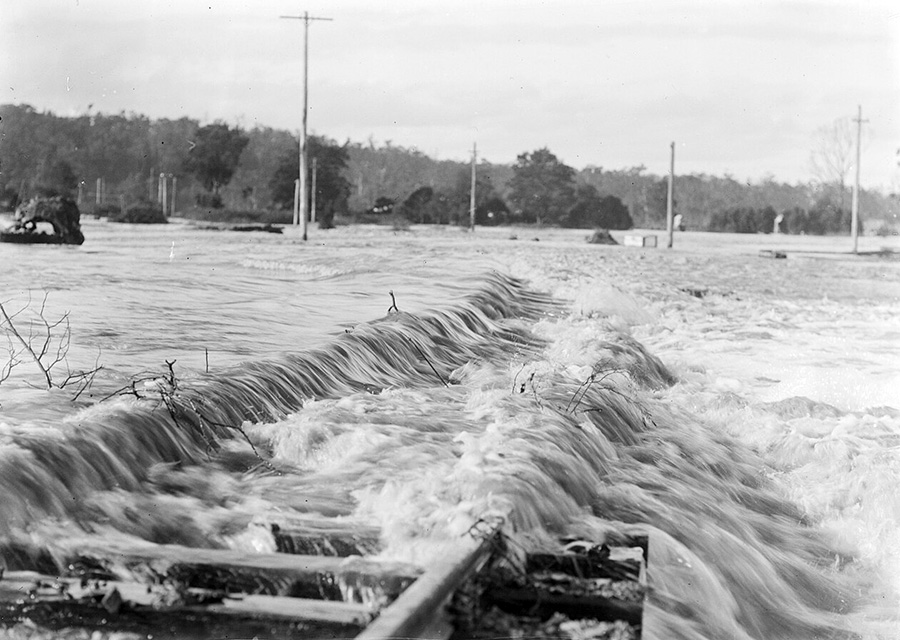
The 1934 Flood

In the year following the floods of 1934, construction of a third nine-hole course, began on C. Murray's property, later the Davey's, on rising hilly ground on School Road, to the east of the town. During its construction in 1935, the keener golfers played on the Warragul club's course on Killarney, a 400-acre property a mile to the east of the Warragul township. Some of the early lady golfers who played at Sunny Creek and later at Murray's were Mrs Hasthorpe, Mrs W. Morrison, Miss Rutcliff (the first associate club champion), Allison and Vera Perrior, Gwen Hasthorpe, Mrs. J. Birch, Mrs. O'Connell, B. Dowie and Mrs. McLaughlin.

The first club champion on Murray's was Bob O'Connell in 1936. Subsequent champions included Harold Perrior, Jim Barker, Eric Donaldson, Joe Marino, and Frank Biggs.

On Wednesday 17th Feb, 1937 for the second time, the club lost its clubhouse to fire.

1934 Victorian floods, the largest in the state's history

1934 Victorian floods, the largest in the state's history


Ashby's and the Thirteen Hole Course

In 1946, the 1st and 2nd holes at Murrays, which were rather steep, were modified. Another four holes were built on flatter ground on the neighbouring Ashby brothers' property taking the course to thirteen holes. The first 5 holes were played twice to make eighteen holes.

The Davey brothers purchased the School Road property while it was an operating golf course. The club continued to play at Davey's until January, 1953 to move to the new course to encourage members to help with the demands of course preparation.

The timber club house was moved from its position on the flat near the butcher's slaughterhouse to the top of the hill on Ashby's where it remained until 1960, when a working bee moved it to the present site. In 1964, the existing club house was completed.

The School Road course had several disadvantages. There were oiled sand 'greens' and local rules such as dropping away from cow pats and fences. The committee decided to seek a new course. A price was set and a sub-committee appointed to attend the auction of the land which became the present site of the club.

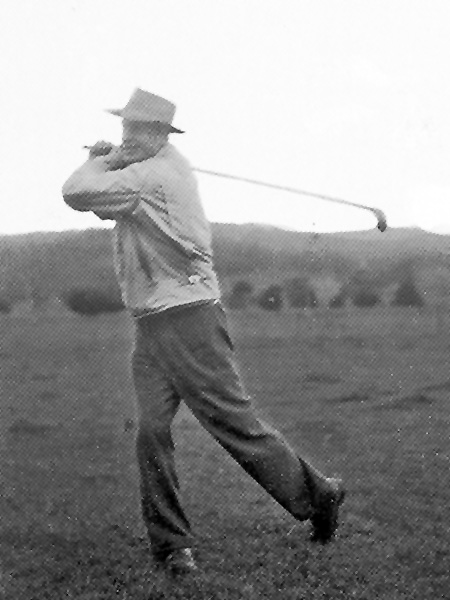
Basil Ashby

Basil Ashby


The Gibsons Rd. Site

1n 1949, a special meeting of members was called to incorporate the club and buy a property for a new course. The present hundred-acre site on Gibsons Rd. came up for auction in November, 1949. The upset price was 4 pounds and 10 shillings per acre ($9 per acre). After a bidding war against a bidder who wanted the land to grow pine trees, it was knocked down to the club for seven pounds ($14 an acre) for the 100 acres. There was also some interest in the land as a sand quarry. Stan Charlesworth, a keen member, provided a loan to the club for the purchase. The property was sandy, well drained and had never been sown with agricultural grasses.

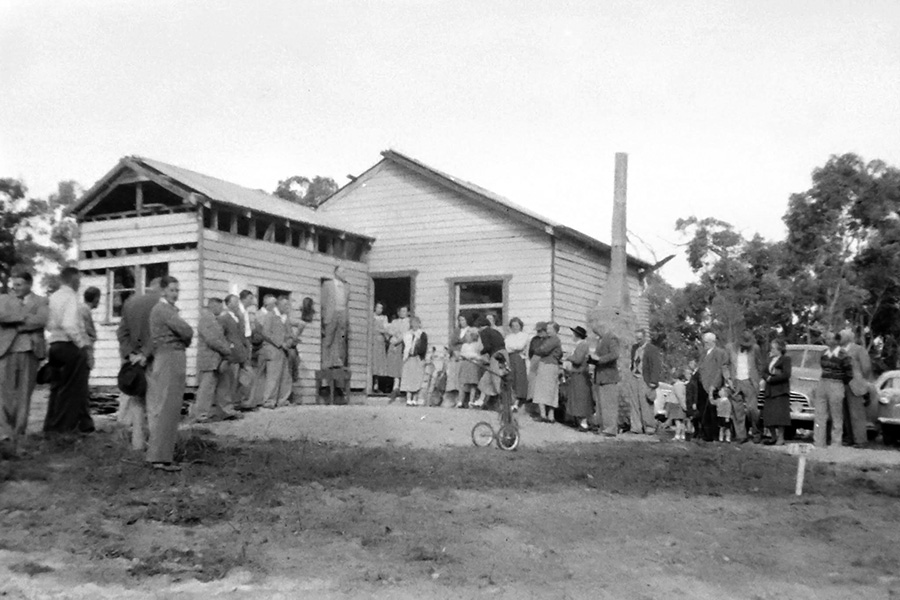
1961 opening of the re-located old club house on the Gibsons Rd. site. (Photo by Forrest Brown)

1961 opening of the re-located old club house on the Gibsons Rd. site. (Photo by Forrest Brown)


Design and Construction of the Current Course

The first design of the new course was by club members Frank Biggs, Les Symons, Eric Donaldson, Albert Morrison, Ivor Ashby, Joe Marino, George Browne and Bob O'Connell with the help of George Lowe, the pro from the Warragul Golf Club. They worked under the supervision of George Browne to lay out the fairway, green and tee positions. The Denereaz brothers bulldozed the fairways at a cost of $1,400.

Lester Tatterson, George Browne and Bonnie Powell were amongst those members and associates who sweated through 'emu parades' picking up sticks, weeding and cleaning up around the course.

The land was covered in dense scrub and it was difficult to see more than five yards ahead. Bulldozers cleared the land and vegetation was burned. Grass was sown. The committee eventually decided with some misgiving to play on the 'horror course'. The greens were bad, the fairways were gaps between rows of bush and heaps of logs. Members worked together and toiled with tractors, plows, harrows, fern hooks, shovels, mattocks and matches and in one season there was considerable improvement. However, enthusiasm waned as the club depended completely on volunteers.

In 1953, because there was some reluctance to play way out of town on the new course, Stan Charlesworth decided to commence playing there in the hope that golfers would see the need to clean it up and prepare it for competition.


Vern Morecom, the Plans for a New Course and Extension to 18 Holes

Years of working bees of members and associates followed with contractors often employed to complete the heavy work. Vic Wilson gave many hours of his time bulldozing, building tees and greens and burning off. Another 6 holes were opened for the back nine in 1957 and the last three holes in 1958, completing the eighteen-hole course. A full-time greenkeeper was employed.

The first water scheme was built by volunteers supervised by Basil Ashby. It was opened in December, 1960 and cost more than £1,800 ($3,600).

In 1961 the club engaged Vern Morcom as course architect to design a new course and he presented his plans to the club in June, 1962. Vern Morcom was the son of legendary Royal Melbourne Greenkeeper, Mick Morcom, who built many of the famous bunkers scattered across Melbourne sand belt courses. As well as greenkeeper, Vern was a highly regarded and prolific golf course designer.

Mick was at Royal Melbourne and Vern at Kingston Heath and these remarkable, but quite different, courses remain the finest in Melbourne. The pair built the famous Royal Melbourne bunkers, as well as others in the Sandbelt such as the famous 15th hole at Kingston Heath. The additional three bunkers finally completed at Trafalgar in 2026 were originally designed by Vern Morcom. His dog-leg holes demand that the long-hitter lays up with an iron shot to avoid going into the bush.

Vern was a prolific course architect after the Second World War and he was head greenkeeper at Kingston Heath from 1928 for nearly 40 years. He designed many fine golf courses across Victoria, including Spring Valley, Anglesea, Curlewis, Lonsdale, Trafalgar, Leongatha, Kyneton, Lakes Entrance, Sandringham and Rosanna as well as interstate at Royal Hobart, Glenelg and Grange (East Course) in South Australia.

At Trafalgar, Morcom made changes to the 1st green, the 4th tee, 6th green, 7th tee, 10th hole (which was lengthened from a par 3 to a par 5 hole), the 12th green, a new 13th hole, 14th tee, 15th tee and green, 16th tee and green, 17th green and 18th tee. These iconic holes make Trafalgar the beautiful course it is today.

The current water scheme was built and opened in 1974. The club house was completed in 1964 by Ron Ireland who was made a Patron Member for his efforts and a liquor licence was obtained in September, 1965.

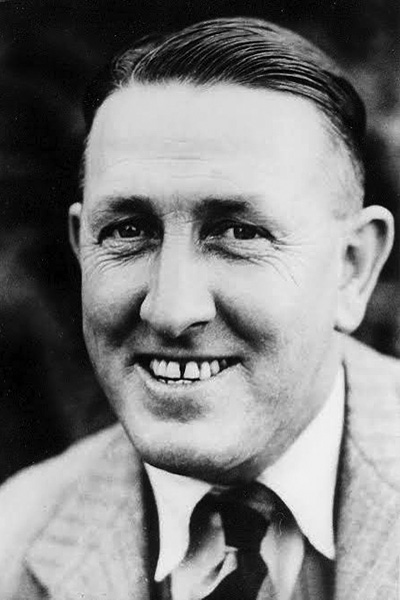
Vern Morcom (1900 - 1976)

Vern Morcom (1900 - 1976)


Recent Improvements and the Future

Over the past fifty years, although the layout has remained largely unchanged, many improvements have been made. A fully reticulated water system utilises bore water pumped into a holding dam next to the 10th fairway. The water is used with an automatic watering system to irrigate greens and tees, keeping the playing surfaces in optimal condition. Significant sub-surface drainage systems have also been installed across the course.

The Late George Browne volunteered to survey the entire new course with tee and green placements. The late Basil Ashby volunteered his mechanical and electrical expertise. Both were honoured with life membership of the club.

In consultation with acclaimed golfer, Michael Clayton, the 5th green and bunkers were modified. More recently, under the guidance of the greens committee and turf professionals, the fairways have been sewn with Santa Ana couch grass, providing fairways comparable with many leading metropolitan courses. The committee remains dedicated to ongoing maintenance and capital works programs and strengthening the status of the club as one of the leading golf courses in country Victoria.


The Bores

The late Roger Matthews told many stories of people around the golf club, most of which were probably legally actionable. This is none of those stories. Soon after work on the course on Gibsons Road was begun, it was decided that reticulated water should be supplied for the course. A water diviner was engaged, and he duly arrived with his ‘y’-shaped willow forks. He walked the course for some time until his sticks dipped to the ground, indicating the presence of water between the tenth and fourteenth holes. A well was drilled and a good flow of water found, exactly as the diviner said it would be.

Some time later, it was decided that another bore should be sunk and the same diviner was presently summoned, based on his previous success. Again, he did not disappoint and his willow proved successful, this time on the eastern side of the tenth fairway. Another bore was sunk, water fairly gushed and this bore keeps the main dam filled even in the driest of summers.

A hydrologist later pointed out that an underground river, many miles wide, flows beneath the course, from Mt Baw Baw to the Strzelecki Ranges and water could be found anywhere on the course.


A Minor Correction

Some time ago, the club received the following communication from Steve Caldow (1960-1994).

“I was reading the History part of your website and I wondered whether you are interested in a minor correction regarding the clubhouse history. My family and I had begun playing golf at Trafalgar in 1960-1.

On the club’s website you state the clubhouse moved out to the existing site until 1964, when in fact it was removed by a large group of members in a working bee in 1960-1.

The clubhouse was moved to the top of the hill on Ashby’s where it stayed until 1953. It was then moved again to the present golf course with a working bee. Here it was used until the existing clubhouse was completed in 1964.

My first ever working bee was the removal of the clubhouse to prep the site for the new clubhouse in 1960-1. They used Jack Caldow’s tipper truck to cart away the building materials, and to ferry the fireplace and chimney bricks to the dam where they were placed in the dam wall at the water line to stop erosion.

So, while the clubhouse was being built, the members used a tin shed for shelter and a bar.

I believe Jim Bellingham may have been the first person to put a ball through a window in the new clubhouse, achieving the feat from the tenth tee, into the men’s urinal, unbelievable!!”

The

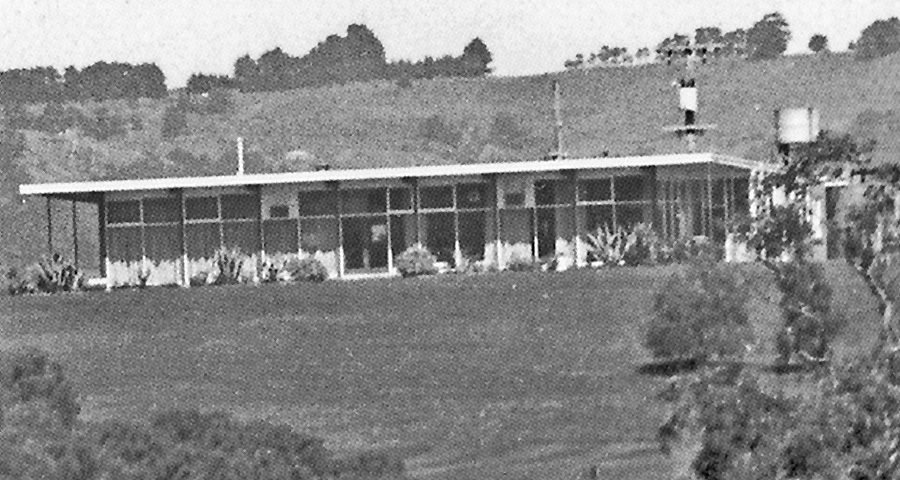
The "new" clubhouse, 1965


Compiled and edited by Peter Cooke, 2026


© Copyright 2026 Trafalgar Golf Club Inc. All rights reserved.

Website